Why OUR Community MUST Care About Climate!
Ansel Ahabue-Itua
It is well-documented that underserved communities will bear the brunt of climate change and pollution. According to a report by the EPA in 2021, underserved communities are less able to prepare for and recover from heat waves, deteriorating air quality, flooding, and other climate enormities. Communities that have suffered, and continue to suffer, from racially-charged neglect or abuse will unravel the most severely from environmental pressure, and poorer communities have fewer resources to adequately mitigate or even adapt to a bleak forecast of multiplying extreme events. Likewise does their capacity to maintain good health also suffer, with pollution taking a heavy toll on the development of children and increasing incidence of debilitating respiratory diseases. The expected growth in heat-related illnesses and deaths among low-income households, traditional communities of color and of immigrants, and the homeless, is particularly alarming.
SPOTLIGHT: Southeast Virginia’s Deadly Heat Wave
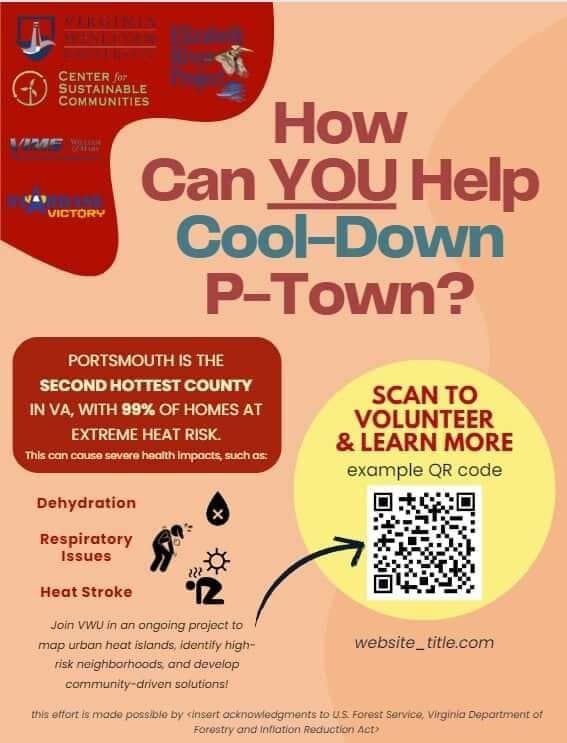
Environmental justice initiatives can raise community awareness of even the most daunting existential threat towards a city’s well-being: the urban heat island effect (UHI) exacerbated by the both poor urban planning not allowing for nature and greenhouse gas emissions. In Portsmouth, Virginia, Garry Harris’s Center for Sustainable Communities co-initiated an encompassing volunteering and training program, where participants were trained to collect data on local daily temperatures to identify heat islands and high-risk neighborhoods. This data will target both those with institutional power (policymakers) so that they can now formulate informed and mitigating public policy, and those without institutional power (community members) so that they are conscious of the real and deadly consequences of environmental injustice.
SPOTLIGHT: Shockoe Hill African Burial Ground
In addition to destroying the environment, negligence also damages sites of great historical importance. The Shockoe Hill African Burial Ground in Richmond, Virginia, is one of the largest of its kind in the United States, but has been partially destroyed due to reckless infrastructure projects in the past. In fact, the track that runs between Richmond’s two main train stations was laid directly upon the Burial Ground’s graves. Nowadays it remains threatened by potential expansion of rail services. Communities seeking to realize racial justice will find that the struggle to realize environmental justice is congruent. Namely, in both cases, the stakes consist of the right to long-term planning, the right to sensitivity to nature, and the right to inclusive and people-centered development.
https://www.cbsnews.com/video/descendent-works-to-reclaim-virginia-african-american-burial-ground/
 National Environmental Justice Institute